
How to Write Your Wedding Vows: A Step-by-Step Guide
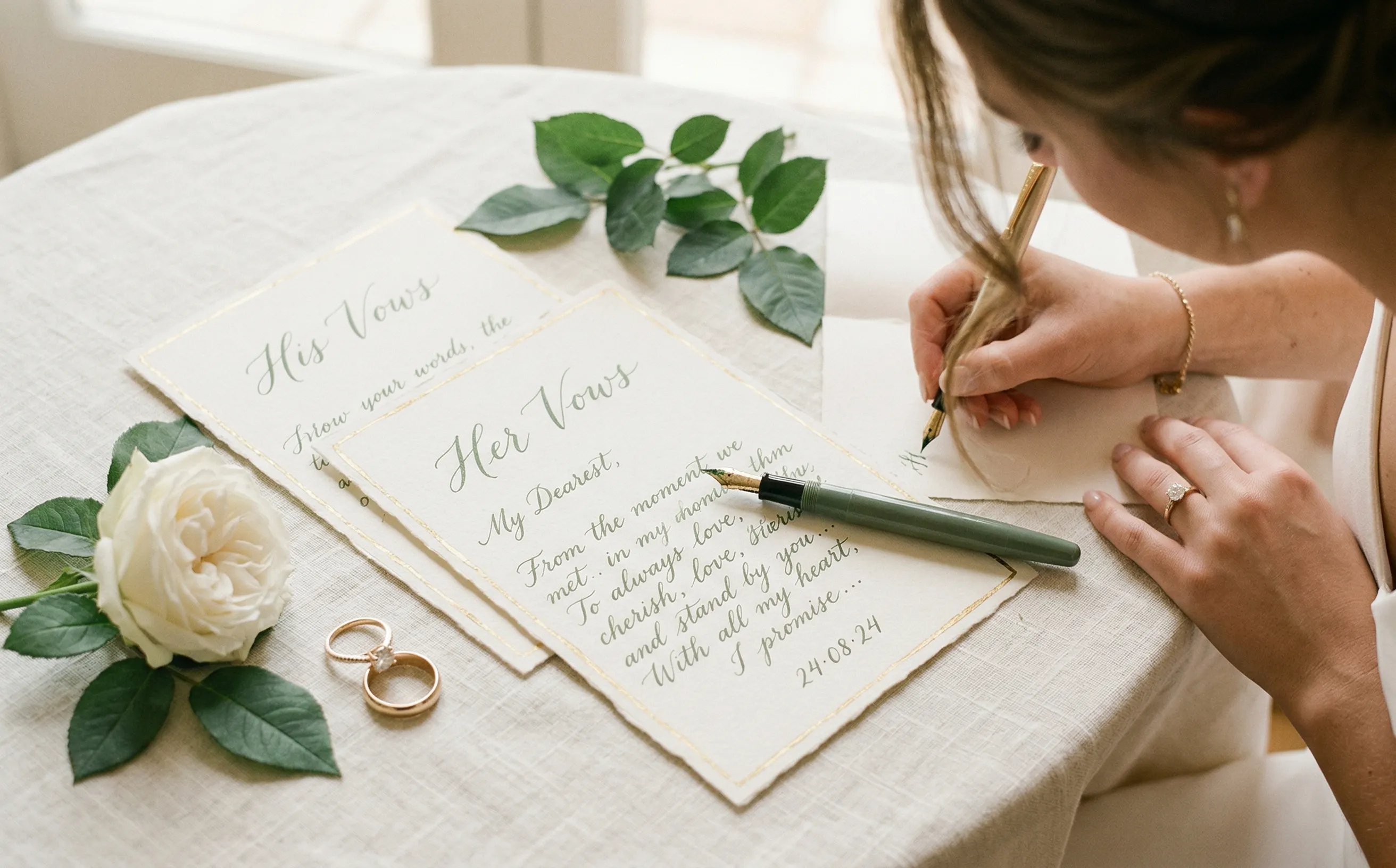
Writing your own vows is one of the most personal things you’ll do for your wedding — and one of the most procrastinated. Here’s a framework that makes it less daunting and more genuine.
26 February 2026 · 7 min read · Last reviewed April 2026
Key takeaways
- Vows work best at 150–300 words (1–2 minutes spoken) — shorter than most couples expect.
- Start with brainstorming, not writing; answer questions about your partner before attempting composition.
- Specificity makes vows memorable — concrete personal details matter more than poetic language.
- Coordinate with your partner on tone and approximate length before either of you starts writing.
- In Australia, legal vows are prescribed by law — personal vows are added separately around the required words.
Start with brainstorming, not writing
Don't open a blank document and try to write poetically. Start by answering questions: When did you know they were the one? What do they do that nobody else does? What are you most excited about in your future together? What promises do you want to make? Write messy, unfiltered answers. The vows come from editing these down.
Choose your tone
Funny and heartfelt? Serious and poetic? Conversational? Your vows should sound like you — not like a greeting card. If you're naturally funny, lean into it. If you're not, don't force it. Genuine warmth always beats forced humour.
Follow a simple structure
A strong set of vows has three parts: (1) What I love about you — a specific quality, moment, or trait. (2) What you mean to me — how you've changed my life. (3) What I promise — the commitments you're making. This gives you a beginning, middle, and end without overthinking it.
Be specific, not generic
"I love your laugh" is forgettable. "I love the way you laugh so hard at your own jokes that you can't finish telling them" is memorable. Specificity is what makes vows feel personal. Use real moments, real habits, real details.
Keep it to 1–2 minutes
That's roughly 150–300 words. Shorter than you think — and that's the point. Long vows lose the audience and dilute the emotion. Say what matters, then stop.
Coordinate with your partner
You don't need to share what you've written, but agree on: approximate length, tone (both funny? both serious?), and whether you're reading from paper or memorising. Mismatched vows — one person reads 3 minutes of poetry while the other says 30 seconds — is awkward.
Practise out loud
Read your vows aloud at least 3 times. You'll catch phrases that sound good on paper but feel wrong when spoken. You'll also find where you naturally pause, where your voice catches, and where you need to slow down.
Writing prompts to get you started
If you’re staring at a blank page, start with these sentence starters. Write freely — you can edit later.
Try our AI vow generator
Still stuck? Our free AI vow generator turns a few details about you and your partner into a complete draft you can edit in your own voice. No signup, no credit card — pick a tone, share what you love about your partner, and read back the result.
Traditional vs personal vows
You don’t have to choose one or the other. Many couples include the traditional vows (required in some ceremonies) and add personal vows on top. Ask your celebrant what’s required legally in your country:
- Australia: Legal vows are prescribed — your celebrant will guide you. Personal vows are added separately.
- UK: Church of England has set vows. Civil ceremonies allow some customisation.
- US/CA/NZ: More flexibility — most celebrants allow fully custom vows.
On the day
- Print your vows on nice card stock — not your phone. Cards look better in photos and don’t run out of battery.
- Give a copy to your celebrant as backup.
- Speak slowly. Emotion will make you rush. Pause after the big lines.
- Make eye contact. Look at your partner, not the card.
Plan the ceremony timing with our timeline builder — vows typically take 2–5 minutes within a 20–40 minute ceremony.
Sources
Frequently asked questions
How long should wedding vows be?
Most wedding celebrants recommend 1–2 minutes per person, which works out to 150–300 words. Shorter is usually better — emotion carries more weight than length, and a concise set of vows keeps the ceremony moving for guests.
Should couples share their vows with each other before the wedding?
You don’t need to share the content, but you should coordinate on tone (both funny, both serious, or mixed) and approximate length. Mismatched vows — where one person reads three minutes of poetry and the other says 30 seconds — can feel awkward in the moment.
What should you not say in wedding vows?
Avoid generic phrases like “you are my best friend” or “I love you more than words can say” — they’re forgettable. Don’t reference inside jokes only you two understand, and avoid conditional promises (“as long as you...”). Keep the tone warm and direct.
Can you use traditional vows and personal vows?
Yes, and in some countries you must. In Australia, the legal wording is prescribed by the Marriage Act — your celebrant will guide you through the required words. Personal vows are then added separately, either before or after the legal portion. Check with your celebrant on the exact structure for your ceremony.
What if I cry during my vows?
Stop, breathe, and wait. The room will not be impatient — this is one of the most genuine moments of the entire day. Practising your vows aloud several times before the wedding helps enormously, because you’ll have already processed the emotional weight of the words by the time you say them at the altar.
Ivory Lane Editorial
The Ivory Lane editorial team covers wedding planning, budgeting, and vendor advice for Australian couples. Our guides are reviewed regularly to reflect current pricing and industry practice.